

The Wisdom Paradox
The curious way we grow in wisdom

Hello!
A thought on the intriguing nature of wisdom this week.
I hope your August’s are going well. See you next week, maybe a little wiser, maybe not.
Jono
P.S. Probably no one cares but me, but I had fun with the repeating Great Wave formed from the version I drew for the cover of Big Ideas Little Pictures. Visit Sketchplanations on a desktop browser for the best view.
Wisdom is a strange thing.
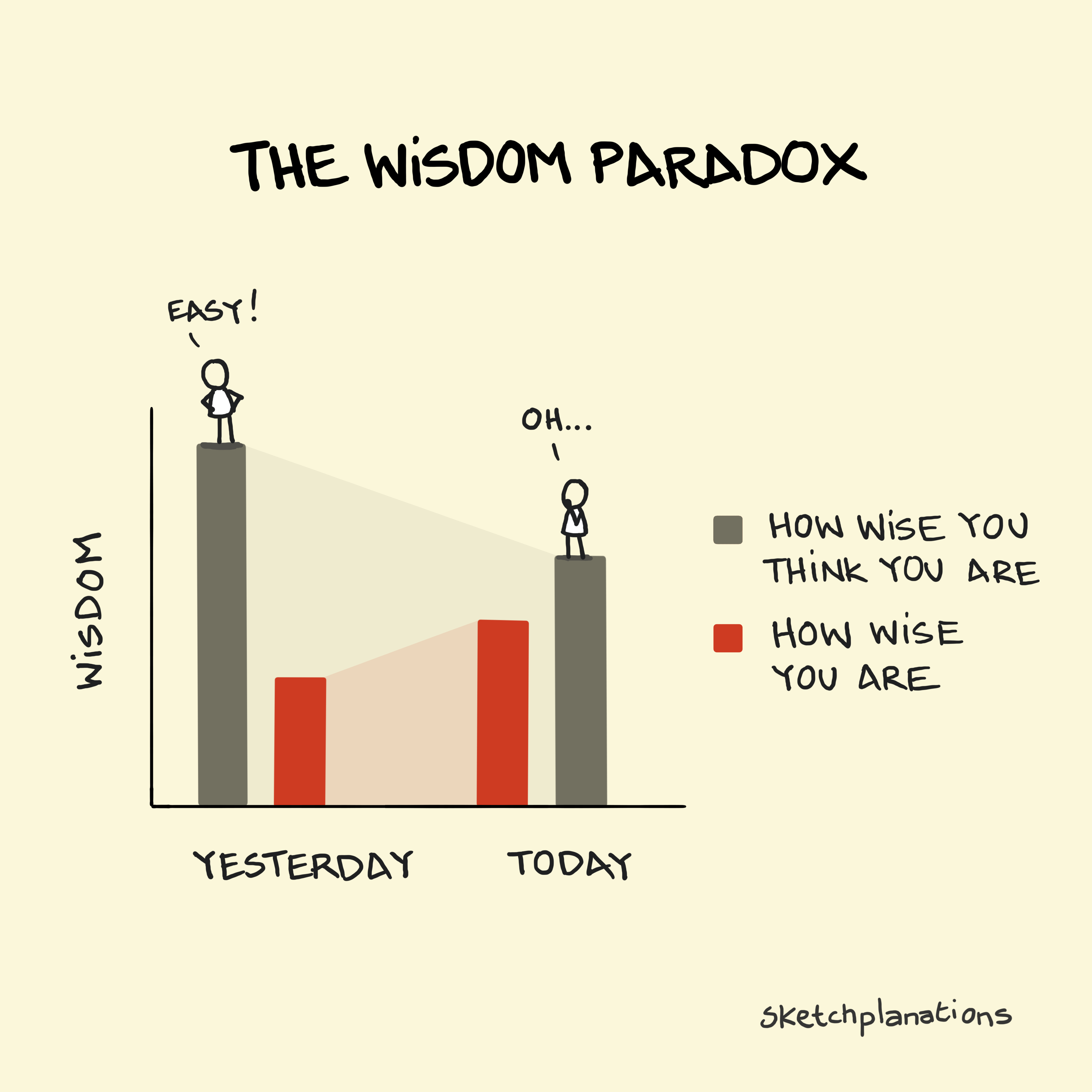
The Wisdom Paradox is this: when we realise we are less wise than we thought, we become wiser.
Anthony de Mello, in his book One-Minute Wisdom, relates a master’s thoughts on wisdom:
It always pleased the Master to hear people recognize their ignorance. “Wisdom tends to grow in proportion to one’s awareness of one’s ignorance,” he claimed.
When asked for an explanation, he said, “When you come to see you are not as wise today as you thought you were yesterday, you are wiser today.”
Or as the popular wisdom goes:
Good judgment comes from experience, and experience comes from bad judgment.
The naivety of youth is a lovely thing. As a teenager, you can be sure that the grown-ups are doing it all wrong, and the path to better is obvious. Then, as an adult, it somehow seems more difficult than before.
My experience is that most things are harder than I thought they would be. Perhaps after getting something to work, I’m wiser than I was before I started, when I thought it would be easy. But I keep making that mistake, which perhaps shows how slowly wisdom arrives.
That which seems like a false step is just the next step.
— Agnes Martin
The fool doth think he is wise, but the wise man knows himself to be a fool.
— William Shakespeare
As You Like It, Act 5, Scene 1
A step backwards after making a wrong turn is a step in the right direction.
— Kurt Vonnegut
Related Ideas to the Wisdom Paradox
Also see:
The Dunning-Kruger Effect
I did this sketch for Big Ideas Little Pictures, but I ran out of space to include it (and am not allowed to post it online yet). Send me proof of purchase, and I’ll send it to you.The judgment and experience quote also has its own sketch in Big Ideas Little Pictures, p.126


Someone measured this, and the numbers surprised me. Rozenblit and Keil had people rate how well they understand a flush toilet, then write out how one actually works, then rate themselves again. The average went 3.89 to 3.10.
What got me is that independent raters scored those same written explanations at 2.72. So even after writing it out, people were still rating themselves above what they'd put on the page. It took one more question to get them to 2.49.
I have a doubt.
I usually have arguments with people. Some people really give good counter arguments. If their counter argument is valid and thoughtful, I acknowledge them and view them as someone wiser
But I also get hate comments and dismissal for my arguments. I'll try my best to convince them but they simply shift the conversation to something else which is unrelated to the topic or simply deny me with comments like "you are an idiot". So I view them as people less wiser than me because they frame me as something instead of giving me some criticism.
According to first scenario I am wiser because I acknowledged someone wiser. But in second scenario am I less wiser because I considered them less wiser and viewed it waste of time to convince them.
Now am I wise one or less wiser one.
I assume environment around us can also influence on the way we think. If I am around idiots, I am most likely to think “I am a wise one”. But I am surrounded by thoughtful people, I learn new things occasionally which makes me think “I still have a lot to learn so I am less wiser one”