

SMART Goals
Turning vague, fuzzy goals into better ones

Wishing you a smashing 2026. Thanks for sticking with my little project.
In case this season of reflection has given you any thoughts, please send any ideas and advice my way for what you’d like to see more of this year. Just hit reply or add a comment. Or perhaps there’s someone you know who might enjoy receiving these. I really appreciate everyone who helps share.
You may or may not be into setting resolutions and goals. But if you are, perhaps this classic goal setting framework might improve your chances of success a little. Hope it might help!
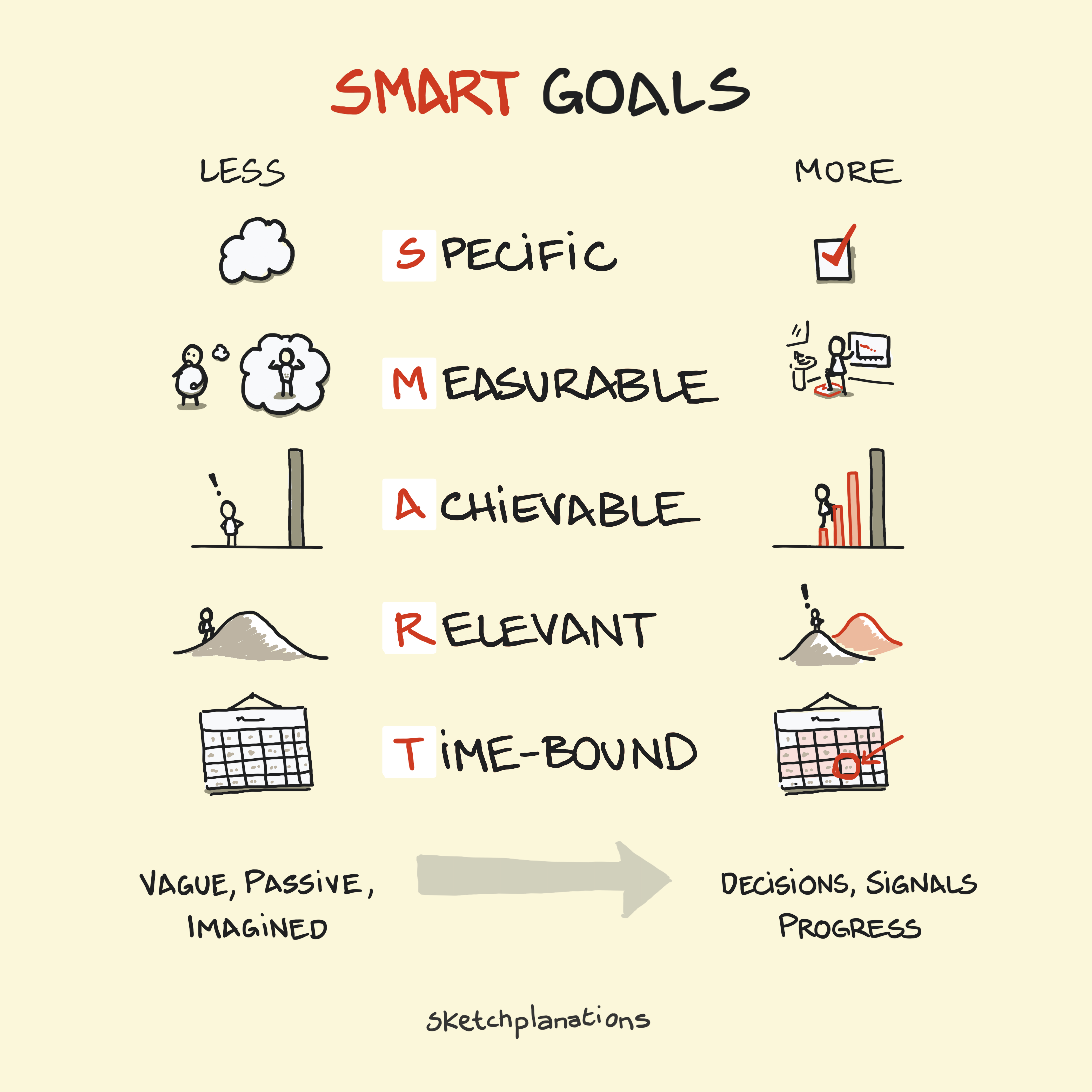
If you’ve heard of one framework to help with goal-setting, it could well be this one: SMART Goals.
SMART is an acronym to keep in mind a few ideas for setting better goals, ones you’re more likely to make progress on and complete. I’ve lost track of when I first learned it, and I do keep it in mind when I set goals. Running through as a little mental checklist helps me go from vague, easy-to-ignore goals to ones with more tangible progress.
What are SMART Goals
SMART stands for:
Specific
Avoid vague, fuzzy goalsMeasurable
How will you see your progress, and when you’ve achieved it?Achievable
Are you able to control and influence your progress?Relevant
Is it really what will help you most?Time-Bound
A timeline and deadline spur action
I’ve seen some variation in the words, in particular with Achievable, Attainable, or Actionable, Relevant or Realistic, Time-Bound and Timely. Either way, the broad intent, as I understand it, is generally the same: turning vague, passive, and imagined goals into decisions, signals, and progress.
SMART Goals help you go from something like:
Next year I will get fit
to:
I will run three times a week, aiming for a 10k personal best in July
I have found that if I do actually want to make progress and not just make the same goal next year, the second formulation here will help me.
There are many goal-setting frameworks. And there’s advice to focus on habits and systems rather than goals (see, for example, Atomic Habits). SMART isn’t always the answer and at times other strategies might serve you better. Use what works for you.
How I use SMART Goals
I’ve definitely found SMART help me over the years. Here’s how I think about each of the aspects of SMART Goals:
Specific
Specific is better than vague. Just like breaking down a big project makes it easier to get started on, getting specific helps me focus on something I’m more likely to act on. Try more new foods, I find, is not as good as Cook one new meal a week.
Getting specific forces you to think about how you will make progress on your goal. There are many different ways, and I sometimes find that I didn’t choose the right thing. No matter, just switch it up when you find what really helps you.
See Implementation intentions.
Measurable
I have been involved in several projects at work where we made changes only to realise we had no way of knowing whether they improved things.
Sometimes we hadn’t bothered to take a measurement before we started working on it. Other times, we hadn’t included a way to measure an outcome from the change we made. These projects weren’t very satisfying.
Keeping your goals measurable helps you know if you’re making things better, and is more motivating along the way (see Flow).
For example, measurable helps you go from “Improve the onboarding experience“ to “Improve the satisfaction score post-onboarding by 50%.” Or ”Get healthier” to “Lose 3 kilograms”.
Sometimes changes in what you really care about may take time, and you may need to consider leading rather than lagging metrics.
Achievable
It’s miserable and demotivating working on goals you stand no chance of hitting. It’s great to think big (as in the BHAG: Big Hairy Audacious Goal) and, in my experience, it also helps to set goals that are hard but that you stand a chance of getting close to.
I have spent a year or more working on company goals that no one really believed we had a chance to hit. Missing it every week is no fun.
It’s not always easy to set a specific, measurable goal that’s achievable, usually because I don’t always have a good sense for what’s possible. Fortunately, goal-setting doesn’t have to be a one-time exercise.
If you set something too high or too low because you didn’t know what was possible, readjust. And if nothing else, you’ll have made progress and be wiser.
If your goal is to run a sub-3-hour marathon but you’ve never really run before, you might be better off starting with “Complete a half-marathon,” until you know how hard running a sub-3-hour marathon is (it’s very hard).
Relevant
The idea with Relevant goals is that they are the most important ones. It can require some thinking about what you really want to achieve. You don’t want to climb the wrong mountain. A little thought to check I’m really on the right path at the beginning is helpful.
Time-Bound
This is a reminder to me that a goal without an end is very easy to ignore. Setting a timeline and end date allows me to plan and forces me to make progress even when I don’t want to.
—
Anything I’ve missed about how you use this framework? Let me know.
And if you’re using this time to set some new goals this year, good luck, and I hope some of these may help.
Jono
Related Ideas to SMART Goals
Apparently, as for productivity, I think about goal-setting a lot. Here are some other concepts that might help when setting or working on your SMART goals:
Goodhart’s Law—very relevant if you’re setting goals for others (podcast episode)
I use these all the time for work - both for service users and personal development. Not always easy to produce, but very useful.
I had just studied theory about SMART, but actually I find this can be useful to archieve (or make progress) towards my 2026...which I'm trying to get serious about. Thanks