


Today is sketch 1,000.
Gosh.
If you will, please let me show you a little about the journey and what it feels like to reach this milestone. And, in this week’s sketch, I share some thoughts on the process I’ve slowly developed to get here. Accordingly, it’s a little longer than usual.
But first…
Thank you for being with me along the way.
Even if you’re just opening your first email from me, or you just occasionally pop along to the website for something, know that you make this worth doing. Whether you’ve been reading for years, forwarding sketches to friends, sharing them at work, sending me ideas and corrections, or just paying attention, thank you.
Some folks have been there from the very beginning. It’s mad to think that you may now share 1,000 things that I’ve learned.
An extra special thank you to everyone who’s been generous enough to support me as a paid subscriber on Substack or on Patreon—in some cases, for years—or have bought me a coffee out of the blue. Your generosity has helped keep this going for everyone, and it’s made a huge difference to why I’m still able to do this now. If that’s you, know I’m very grateful for your support and encouragement.

When I started scribbling in a Moleskine storyboard notebook 13 years ago, I had no idea what I was about to embark on. It’s a little like what I’ve heard from most entrepreneurs, something along the lines of: “If I’d known how hard it was going to be, I wouldn’t have done it…but I’m glad I did.” Type II fun style.
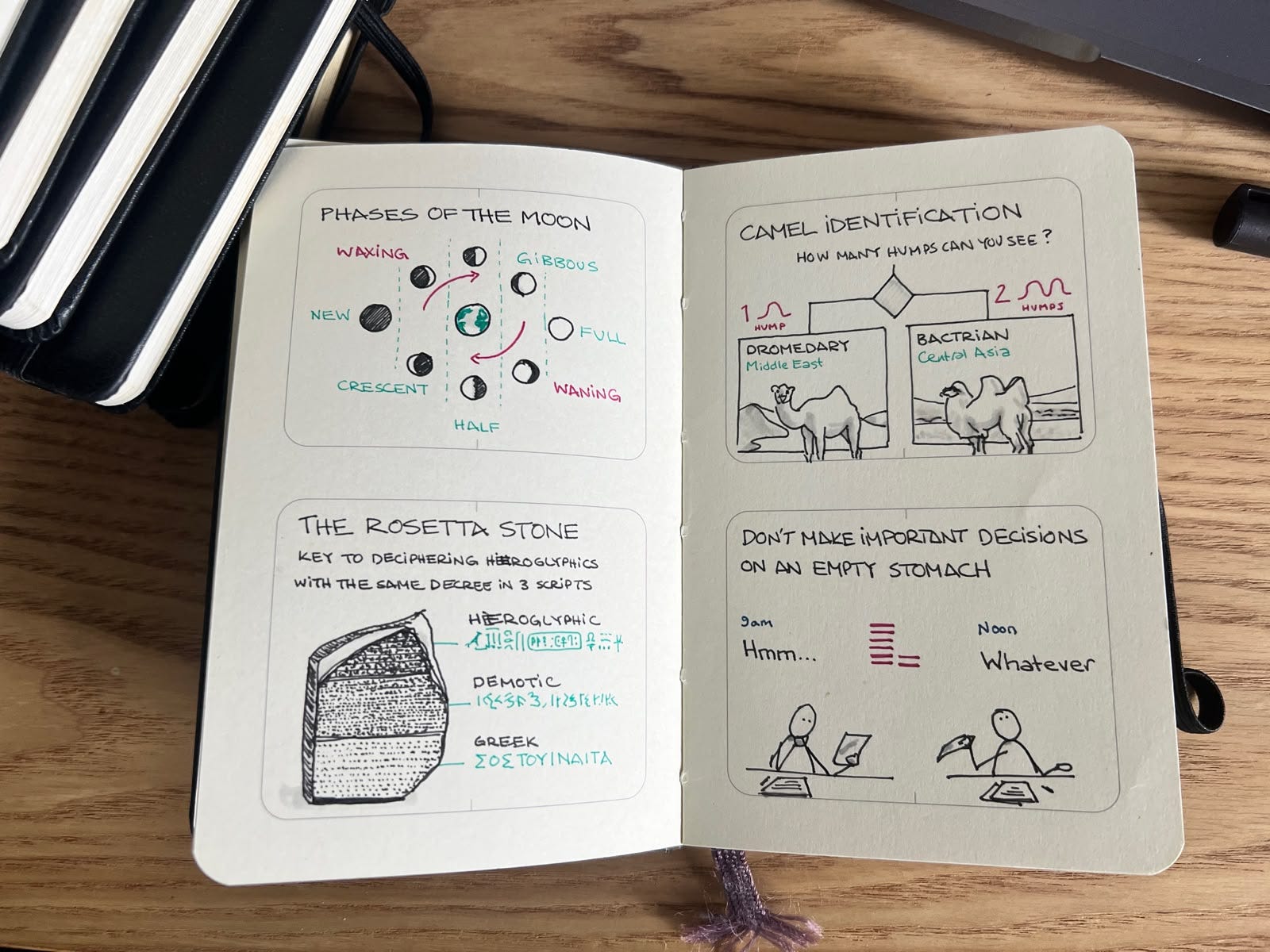
Never did I imagine it would become the thing I say when people ask, “So, what do you do?” Nor did I expect it to get me into bookshops throughout the world.


While the time I spend on sketches now has changed from 2 minutes to, at times, a day or more, the intent is still the same: explain an idea in a sketch.

In some ways, 1,000 feels like a lot, and in others it feels like barely scratching the surface. It reminds me of Isaac Newton’s reflection, “I seem to have been only like a boy playing on the seashore, and diverting myself in now and then finding a smoother pebble or a prettier shell than ordinary, whilst the great ocean of truth lay all undiscovered before me.” My word, there’s still a lot to cover.
In doing 1,000 sketches, somewhere along the way, while trying to add some of the nuance, complexity and what each idea means to me, I also managed to write over 180,000 words. For someone who always preferred drawing to writing, I’m probably more surprised than anyone. I hope you have found the words add something without getting in the way of the visuals.
Over many sketches, I developed a visual language and style that I found suited explaining—itself borrowed from many past influences. As a potential legacy of filling the internet with 1,000 explainers, I don’t know if you’ve tried asking AI for a visual summary of a document, but I’ve noticed that they often come out looking like Sketchplanations. That’s right down to the backgrounds, colour choices, layout, mix of text and visuals, and style of people. Perhaps that’s how the real impact will live on 😅
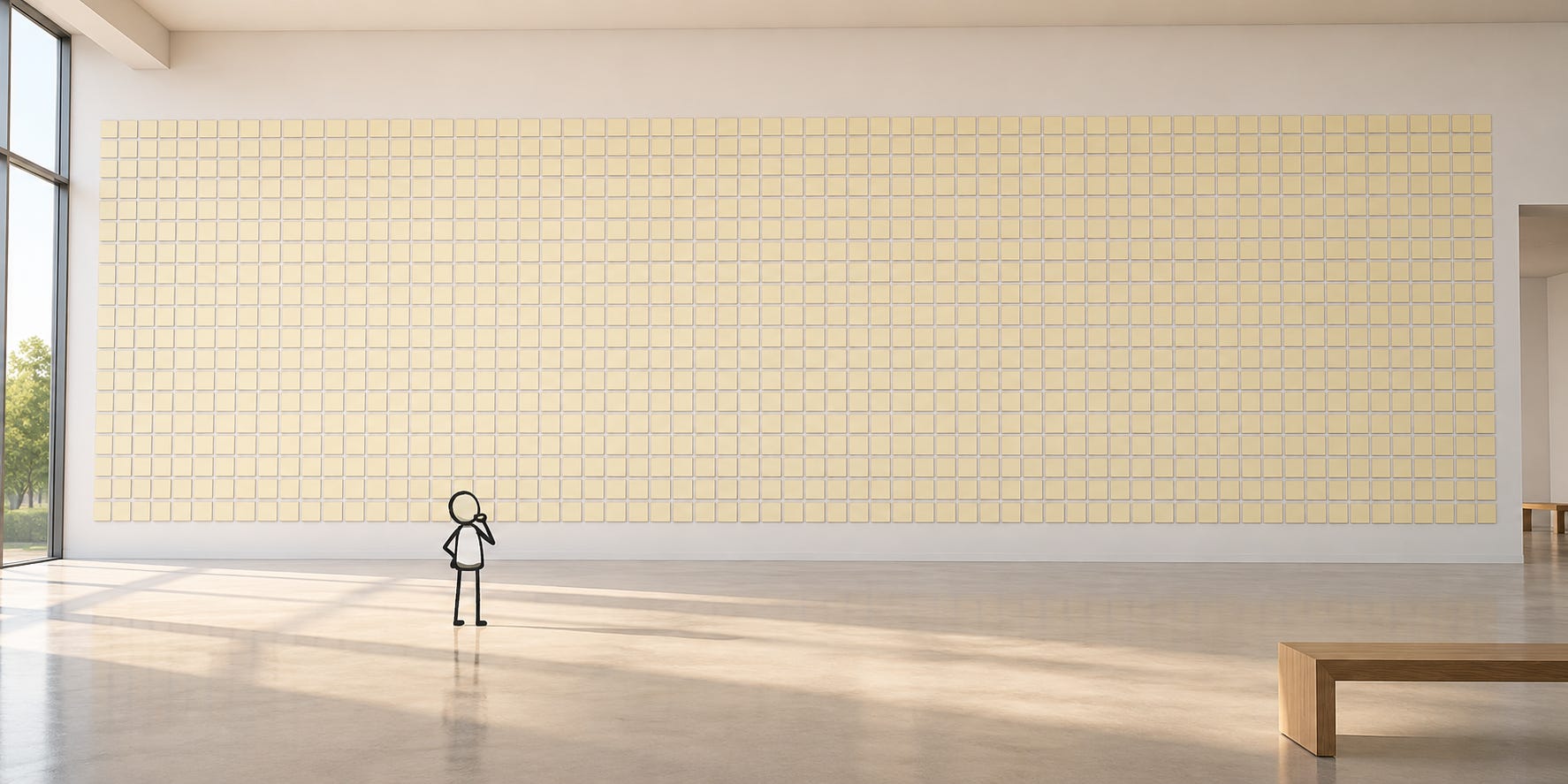
It’s astonishing to me how a small, regular practice accumulates. I have many printed out around our house, and I’ve wondered what it would feel like to see a large collection together in a physical exhibition space, maybe like the image below. If you know of a space, organisation or opportunity that might suit—and perhaps help make it happen—please reply and let me know.
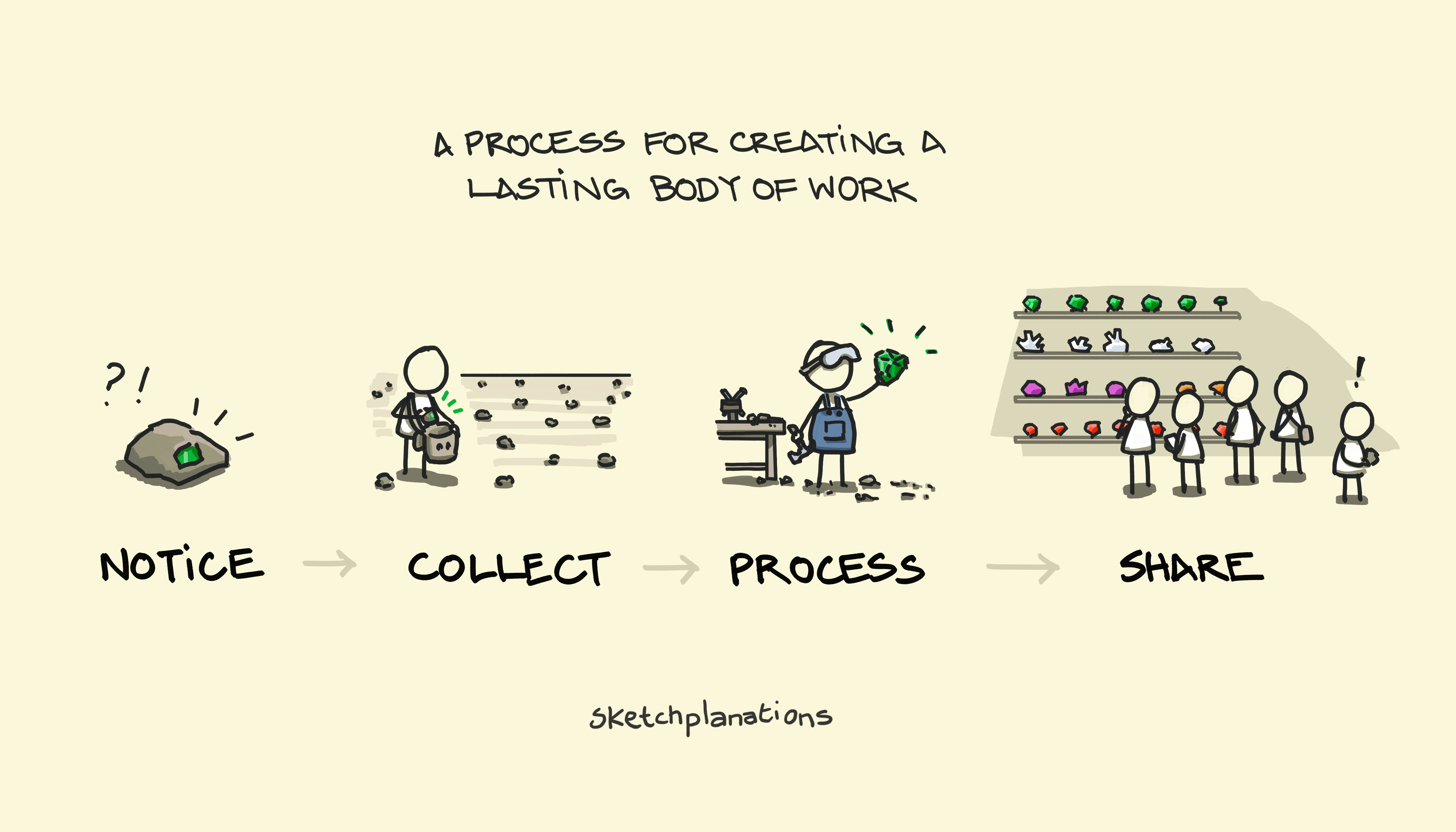
Notice, Collect, Process, Share
The topic of this week’s sketch is a reflection on the process I slowly developed to create this body of visual explanations: Notice, Collect, Process, Share.
(I have Dave Gray to thank for helping me with a first draft of Notice, Collect, Process and Share, while working on a session for his School of the Possible.)
1. Notice
It all starts with noticing
We all have our own unique perspective, influences and things that attract us. Noticing is not drifting through life but paying attention to it.
I think it’s possible to develop a habit of curiosity and a questioning approach. But noticing can be as simple as a small mental note when we find something we like. I’m not sure of the best way to cultivate a habit of noticing, but Rob Walker writes a popular newsletter on The Art of Noticing, I’m sure you will find something in there.
Over the years, I have trained myself to notice ideas. They might be ideas I’ve found valuable and found myself sharing with others in conversations. Or concepts in books. Or insights that I think are valuable but not widely known. Or ideas that are not easily accessible and more people could benefit from them.
I’ve been doing this for long enough that people now share ideas with me that they think I should include. It’s great. I learn so much.
2. Collect
Build a collection
For people who want to start a creative practice, I often suggest starting collections.
One quote is an interesting lesson. Many quotes can be a book.
Collecting can be as simple as noting things down in one place—maybe a notebook, or the notes file on your phone. It can be just clicking like or save when you hear a song you like. I started collecting quotes using a to-do list app.
Noting each one down forces you to pay it a little more attention, helps it stick in your memory, and gives you a chance to come across it again.
When you start the simple process of collecting, you can start to see patterns. You can see what fits together, make connections others may not, and discover what really interests you.
My list for future sketchplanations is now many hundreds strong.
A small tip: jot down where you found whatever it is you’re collecting. It’s evident when you note it down, but may not be so obvious when you revisit it, perhaps years later. Your future self will be grateful.
3. Process
Process your collection
You don’t have to do much for this step. Many collections are simply thrown up onto sites like Reddit and people get some value from it. But I think most collections benefit from a little work on each.
It can be a small, consistent action.
Identifying and naming butterflies, or sorting them by location, size or colour, makes the collection more valuable than a shoebox full of photos of them.
Sorting quotes by theme makes it easier to work with them and easier for readers to learn from them.
A collection of songs in the right order is a winning playlist.
A photographer may have a few steps of cropping, adjusting exposure, applying filters and writing a line about each.
It doesn’t have to be much.
In my case, the work has been to try to distil the essence of an idea and share it concisely in a visual with a somewhat consistent style.
Each week I take an idea from the collection and work on it, transforming it, and applying my own process to shape it in my own way. Your processing will be different.
4. Share
Share it
Working on things for yourself is great. You’ll no doubt be happier and take a lot from it. But I think there’s a lot of value in sharing what you create.
I’ve written some reflections on sharing before. Several things start happening when you share your work.
Others have the chance to discover it and benefit from it.
You’ll often raise your bar when you’re name is attached to it.
You’ll begin to think harder about it and do a better job.
If you set out on your work of processing the thing with the idea that you will be sharing it, it encourages you to consider how others might engage with the work and makes it stronger.
Others may provide encouragement, motivation, or support, and it has a better chance of enduring.
You’ll be surprised at what others find most valuable.
You may inspire others and make a small positive change in the world.
Notice —> Collect —> Process —> Shape
One thing that strikes me, looking back, is that you can deliberately work on and improve at each of these steps.
Is there something you already notice that you could start collecting, processing and sharing? I’d love to hear about it.
Beyond 1,000?
I never set out to make 1,000 sketches. I just did one at a time. And with sketch 1001, I’ll keep on trying to do this:

See you next week.
I work for a small company that has an office in the Netherlands, Manilla and Texas. Once a month we have an on-line get-together to talk about a topic other than work. I have used one of your sketches as a conversation topic on a number of occasions. Thank you! I look forward to the next sketch!
🥂 A well deserved congratulations! Thanks for making the world a better place Jono.