

Science and/or Engineering
And when is it one or the other

Back with the new podcast series with some brilliant guests coming up, starting with How to Instantly Feel Better. Have a listen
Having studied engineering but always loved science, I've come across a few perspectives I find useful to understand the two. Along with the one in the sketch, I share them below.
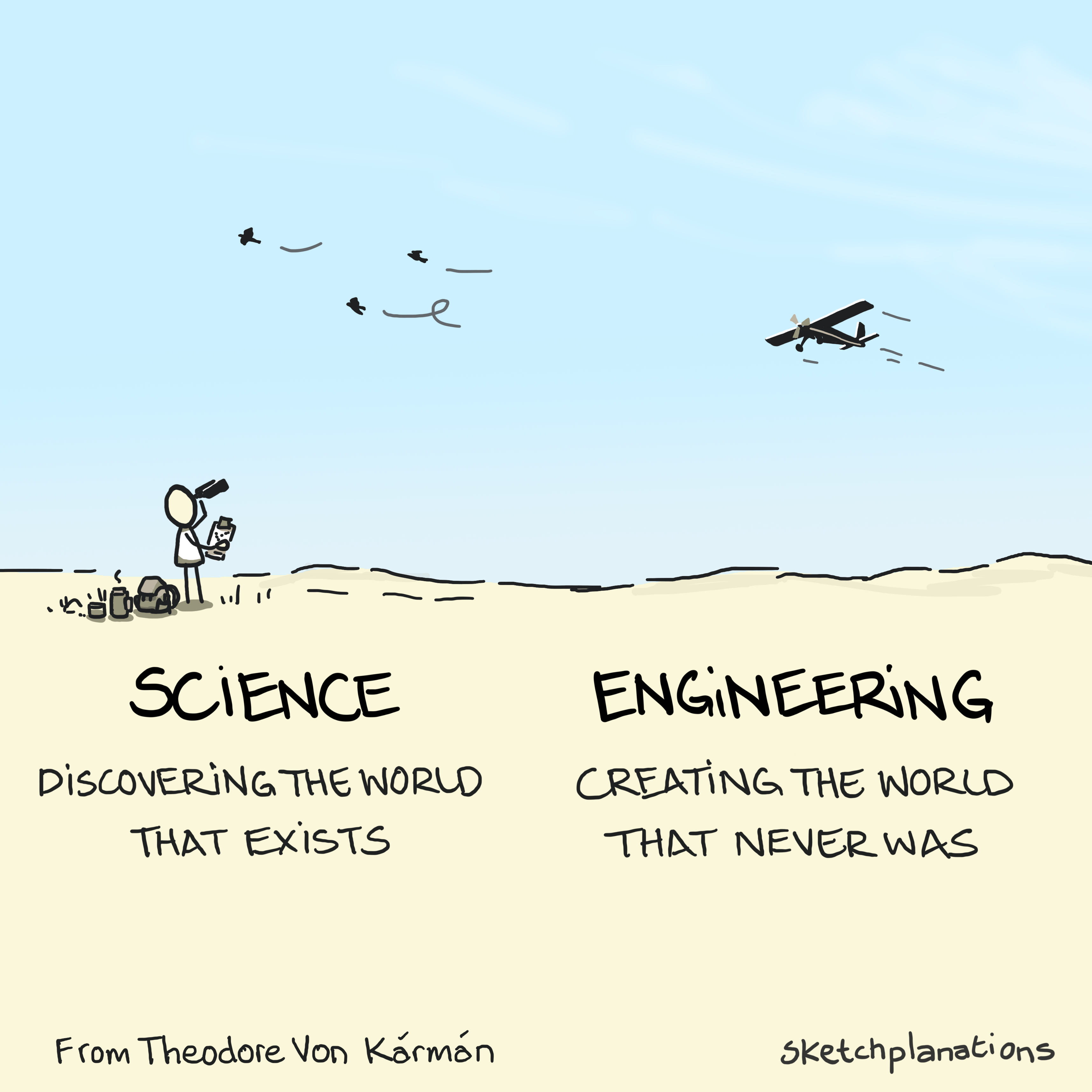
In England at least, studying science usually comes first. In fact, you can't really study engineering until you head off to University. So discussing science and engineering together never came up when I was at school. Engineering seemed to be machines and buildings and projects and design and technology, and science seemed to be everything else. But what really makes science science and engineering engineering?
Science vs Engineering: Four perspectives
Here are four simple ways people have described science and engineering.
Theodore Von Kármán on Scientists and Engineers
Aerospace engineer Theodore Von Kármán said:
Scientists discover the world that exists; Engineers create the world that never was.
— Theodore Von Kármán
Richard Hamming on Science and Engineering
Bell Labs engineer Richard Hamming, in his book The Art of Doing Science and Engineering: Learning to Learn, captured the difference this way:
"In science if you know what you are doing you should not be doing it.
In engineering if you do not know what you are doing you should not be doing it."
— Richard Hamming
Hamming also points out that there's a lot of science in engineering and a lot of engineering in science: "Much of present science rests on engineering tools, and as time goes on, engineering seems to involve more and more of the science part."
For example, dealing with huge amounts of data, of the sort generated by weather sensors or particle colliders, requires exceptional engineering techniques. And engineering new displays or ever smaller processing chips requires a lot of scientific knowledge. The two are intertwined: science enables engineering to push forward, and engineering opens new doors for science.
Richard Feynman on Computer Science
Physicist Richard Feynman, in a talk on quantum computers at Bell Labs (video excerpt), said:
"I don't believe in Computer Science. To me, science is the study of the behavior of nature. And engineering or applied things is the behavior of things we make.
You need to know how Nature works in order to make the things, and so you use science in engineering, but you're doing it for a human purpose."
— Richard Feynman
Mythbusters' Adam Savage on Science vs Screwing Around
Adam Savage, Mythbusters host, shared:
"Remember kids, the only difference between screwing around and science is writing it down."
Adam said that the quote was actually from the ballistics expert on a shoot, Alex Jason. It doesn’t quite get to the heart of science versus engineering, but it’s a great reminder of good practice.
And finally, my own phrasing in the first draft for the sketch used:
Science: Study of the world
Engineering: Doing things with what we've learned about the world
So while there probably isn't a single neat answer to the question of what’s the difference between science and engineering, maybe these give some food for thought.
If you know of other interesting framings for science and engineering, please let me know.
May your week not get caught up in definition-wars,
Jono
Related Ideas to Science and Engineering
Also see:
You Get What You Measure - Richard Hamming
What Gets Measured Gets Better - Richard Hamming
Accuracy and Precision are not the same thing
Thesis, Antithesis, Synthesis a progression of ideas
Greeble (I learned from Adam Savage)
I'm a librarian so my mind immediately goes to the library: In the Dewey Decimal System, the 500 section is all Natural Sciences: observable things about the world. the 600 section is Applied Sciences: technology and how people USE science. eg. A book on astronomy would be in 500 while a book on telescopes or space travel would be in 600. When I explain it to my middle school students, I say, "the 500's are what we can see, the 600's are what we can do."
I think your first-draft version is the more accurate and meaningful -- by a long shot.