

Laplace’s Demon
For an all-seeing, all-knowing being, the future is as clear as the past

Hello! A thought experiment and demon for you this week.
Separately the shop has lots of items on sale at the moment (it’s for Valentine’s Day, but it’s a sale regardless), and ICYMI some new music to listen to.
Laplace’s Demon is a thought experiment—a hypothetical scenario that helps stress-test and illuminate ideas. Thought experiments are something I’ve considered creating a series on. Would that interest you? Hit reply or comment and let me know.
Despite current turbulence, I wish you a great week.
Jono
Perhaps you, like me, have once considered a thought experiment:
Given all the laws of nature and given the current state of everything in the universe, in principle, you could figure out exactly what was going to happen. The laws of nature would just keep things moving as expected, and events in the universe would unfold predictably and imperturbably. What about free will and all that?
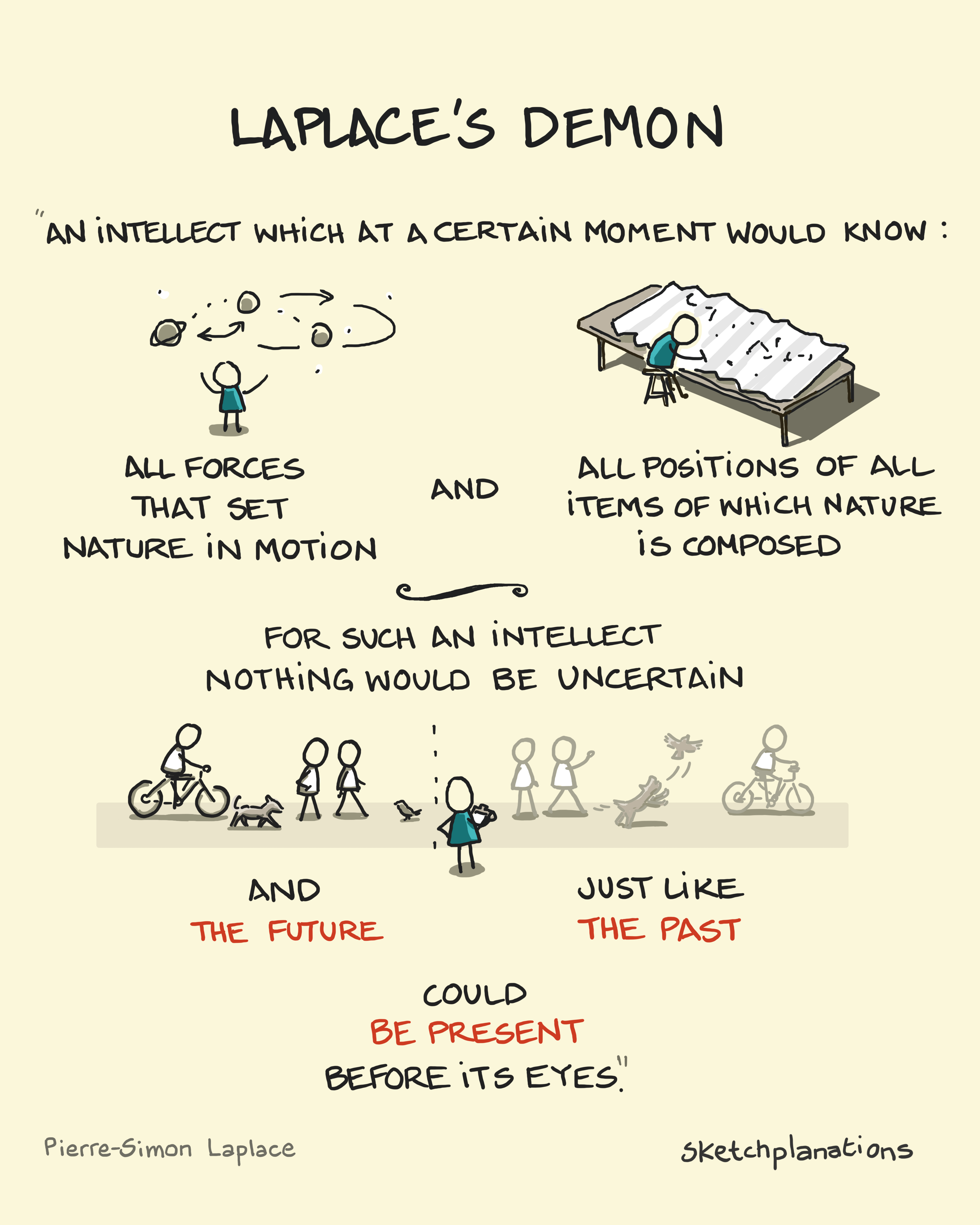
This idea of a being that knew all the laws and the current states of everything, and therefore how everything would play out, is called Laplace’s Demon. It was named after an extremely smart French mathematician and polymath, Pierre-Simon Laplace, who once wrote (translations vary a little):
“We ought then to regard the present state of the universe as the effect of its anterior state and as the cause of the one which is to follow.
Given for one instant an intelligence which could comprehend all the forces by which nature is animated and the respective situation of the beings who compose it—an intelligence sufficiently vast to submit these data to analysis—it would embrace in the same formula the movements of the greatest bodies of the universe and those of the lightest atom;
for it, nothing would be uncertain and the future, as the past, would be present to its eyes.”
— Pierre-Simon Laplace, A Philosophical Essay on Probabilities
Determinism is the idea that everything is pre-determined and nothing is left to chance. Laplace’s Demon thought experiment represents the extreme side of that.
There are a few challenges to this idea since then, including the practical unpredictability of chaotic systems, quantum mechanics, the difficulty of measuring without disturbing, as well as philosophical and religious ideas about free will. Even if the future did follow perfectly from the past, in practice we couldn’t work it out.
Notes on Laplace’s Demon
I learned about Laplace’s Demon in David Spiegelhalter’s The Art of Uncertainty after he joined us on the podcast about microlives. The ‘It’s All A Bit Random’ Chapter has a good discussion of this.
Laplace’s Demon is less well-known than Maxwell’s demon — a teeny being that appears to violate the second law of thermodynamics.
Related Ideas to Laplace’s Demon
Also see:
Laplace’s Demon is an eponym
You can read a translation of Laplace’s words in his article A Philosophical Essay on Probabilities on Project Gutenberg
Yes, please!
I wonder if Asimov had this in mind when he wrote Foundation, and the idea of “psychohistory”?