


Not long ago, I was interviewed about how Sketchplanations began and what I’ve learned from keeping it going. As I approach 1,000 Sketchplanations—just a few weeks away!—It was fun to reflect on the project, and I wanted to share the conversation here.
We talked about lunches spent sketching alone, how tiny notebooks shaped the project, how I handle feedback, and what I’ve learned from building a body of work one small drawing at a time.
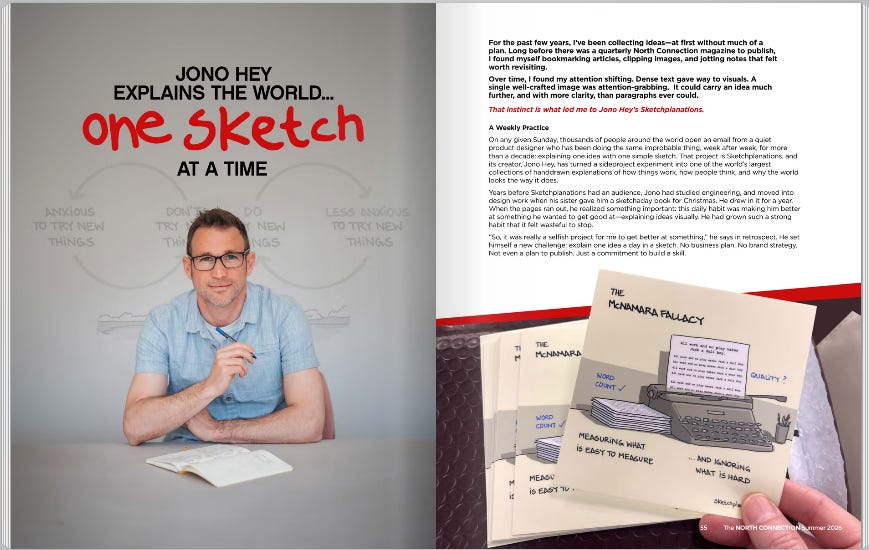
The interview originally appeared in an unlikely place: a quarterly magazine for water treatment professionals run by Dave Fitzgerald. I was really impressed with the quality of the printed feature, and Dave kindly gave me permission to share it here. I’ve edited the interview for length and clarity, and adapted some questions from their original business context.
I hope you enjoy it.
How did Sketchplanations begin?
I started Sketchplanations for myself. I received a sketch-a-day book one Christmas, and I did that for a year. When it finished, it seemed a shame to stop, but I wanted to do something which would help me develop a skill. I worked in design, and explaining in visuals is always useful, so I set out to explain something in a sketch a day. So it was really a selfish project for me to get better at something.
How did you start sharing the sketches—and when did people start paying attention?
Early on, I did the sketches in these small storyboard notebooks. They looked nice with four to a double-page spread, so one day I posted some photos on Facebook. A friend commented that I should put these online. I started a blog for them—Tumblr back then—and added an email form to subscribe to new ones, and people kept signing up. So it was definitely following the interest. Once enough people are paying attention, it becomes hard to stop.
Looking back, which early decisions—about the name, format or schedule—turned out to matter most?
The name, Sketchplanations, has been good. I remember very distinctly when it came to me. It’s unique and says what it is, though it’s a little hard for people to spell and type, and it’s rather long. My book title, Big Ideas Little Pictures, is better, but less distinctive.
Explaining one thing a day for a year is exhausting—at least when it’s not your day job—and so I switched to twice a week. I quickly realised that it didn’t work for me at all. I could always do a sketch tomorrow instead of now. So I switched to weekly, and I think that really works, both for people who already have too many emails and for me as a simple goal I could stick to.
You had a full-time career in design and product work. How did you make time for Sketchplanations alongside a full-time job—and what kept you going?
I remember Arnold Schwarzenegger talking about the power of an hour a day to learn something new. And he’s absolutely right. It wasn’t always easy to keep it up, but I developed some rituals around it that worked.
I ate a lot of lunches on my own for years at work! Often I’d eat, then sketch at a nearby café afterwards. It perhaps made me a bit antisocial, but I appreciated the time to think, and it became a part of my day I’d look forward to.
I’m sure that if I hadn’t put the work out there and created the email list, I would have stopped long ago. The internal pressure of people expecting something from me was enough for me to make myself keep going to deliver what I’d promised—even on many evenings and weekends.
Sometimes I wouldn’t get any feedback for weeks. And then I’d get a note about how my sketches had really helped someone. I keep that in mind during the quiet weeks.
After doing this so long, it’s almost unthinkable not to make time for it now. And I also have a very sympathetic and supportive spouse who lets me make time for it.
Did you have a plan for where this would lead?
I didn’t have a grand vision at first—which is probably good, because it would have seemed so big and my progress so slow that I might have been discouraged.
As the project has progressed, I’ve discovered different ways to share sketches and make them more valuable to people. I’ve learned what topics work well, what keeps me interested, how to help search engines find a site made mostly of images, and where to grow an audience. Along the way, I’ve published a book and developed a bigger ambition: to create one of the world’s largest libraries of explanatory visuals.
How has making and publishing a sketch each week functioned as your version of “learning on the job”?
It’s a fantastic way to improve at something. There isn’t really a manual or best practice to follow for this. Every new sketch is an opportunity to see what works.
Gradually, I evolved a style and have a sense for what ways might work. I’ve tried to note these down, but I still don’t have a magic formula. Some work better than others.
That said, it’s also possible to do a job by running through the motions. It helps to be deliberate about learning and ask yourself what has or hasn’t worked and how you can improve. I try to do that as much as possible.
How do you decide when a sketch is good enough to publish?
Well, one of the nice things about one a week is that sometimes it’s just done because I’ve run out of time. With any product, it’s possible to keep endlessly tweaking for perfection—I write music, and it’s the same there. It’s actually important to have a forcing function, like a deadline or budget, to make sure you say, “Right, that’ll have to be good enough. Let’s get it out there.”
If you don’t ship, you don’t learn.
If something doesn’t work out, then I can put it right on my next one or tidy it up later.
I worked a lot in software, and it’s easier to keep improving and upgrading than with hardware. I think Reid Hoffman’s sentiment that if you’re not embarrassed about the first version of your product, you’ve shipped too late, is helpful.
I look back on old sketches, and I wouldn’t do them like that now, but they got me here.
Can you show a sketch you’ve improved—and explain what changed?
I do a lot of tidying when I revisit old sketches, improving lines, characters, tweaking copy, removing borders and making them consistent with recent quality. But I’ve also realised that part of what makes a good sketchplanation is being able to relate to people in the scene.
My original sketch of the Overview Effect was essentially a drawing of the Apollo Earthrise photo. That view captures the Overview Effect like nothing else. When I revisited it, I added two astronauts, one of them sitting down “having a moment.”
I realised it’s often the people in my sketches that draw you in. They help you consider what you might feel in their position. I also added some faint stars and improved the resolution.


What have you learned about starting before you feel ready?
Over time, I’ve sketched a lot of ideas about what I’ve learned about getting started on something—so much that I have a small book of sketches coming out on it. It’s so easy not to start. It’s so easy to make excuses as to why you can’t get going on something, or why it’s not the right time.
I remember speaking with a professor at UC Berkeley who’d just had a baby in an already very busy year. I said that it probably wasn’t great timing, and he said, “I’m not sure there’s ever the right time to have a baby.”
If you’re going to do something, sometimes you just have to start and figure it out later.
How has your idea of what Sketchplanations could become changed over time?
As I’ve added more and more concepts to the collection, I’ve changed how I think about it.
At first it was a newsletter and a blog; a sequential collection of what I knew or found interesting—“Here’s a new one this week.” As I covered more categories of ideas, I started thinking of it as a library—each sketch like one more book on a shelf. Lately, I think of it more like a network. No sketch stands alone. What’s fun, and valuable, is the connections you make with other ideas, building up a point of view as a whole.
It’s still a way for me to learn and get better, and it’s still a way for anyone to find a sketch and maybe learn something new or have something that’s helpful to share. But by connecting the ideas together, I hope it helps build an overall perspective and maybe gives people a new way to think about the world or a subject area.
How do you go from an idea to a finished sketch?
My process, I have come to realise, is: Notice, Collect, Process, Share.
I also often separate finding the right approach for a visual from executing it—like a cartoonist might separate writing a comic from inking it. And I often separate drawing from writing, and from posting and sharing. My mind has to be in different modes to do each one well. The hardest, no doubt, is finding the right approach for the sketch.
How do you choose what to sketch next?
I have trained myself to constantly be learning and noticing and capturing subjects for sketches. Fundamentally, I sketch what I know or what has helped me. But I’m also always learning, listening and reading and am diligent about noting ideas down.
As to what I work on next, it’s usually what I feel most passionate about at the moment, or have the clearest idea of how to execute.
How have constraints helped you make better sketches?
Constraints have been a huge blessing to me. Working in the original storyboard notebooks kept the visuals small. That meant I had to get to the essence of the idea and make the visual do more work. Keeping the sketches small also helped me finish them.
Limiting the colours and pens I used also led to a style and restricted how much time I could spend.
Keeping them small and having the weekly schedule meant that even on weeks I wasn’t motivated, I forced myself to make progress. Sometimes they weren’t great, but sometimes I look back on what I did and I’m impressed. So constraints were so valuable to me.
Where does feedback fit in your process?
I love getting ideas from readers, and I’ve learned a lot from their comments and feedback.
But I’m also a bit stubborn on my vision for the project. If I only followed suggestions, then I would end up pleasing the loudest group, doing sketches of things that didn’t interest me, and building something that I didn’t personally care about. I’ve learned that my unique point of view and experience are part of the value that I bring. Following every suggestion would dilute the project to bleh. Probably!
Sometimes I share visuals and get no response, as if no one cared or no one liked it. But I know that I liked it, and if I’m sketching it, it was probably an aha moment for me at some point. Even if no one seemed to spot that now, I’m confident that someone may get that same aha in the future.
I’ve seen countless times that content shared one week in one place may get no reaction, while the same content shared at another time, place, or by someone else may take off. So I always take any reaction with a pinch of salt.
When you draw, do you picture a specific kind of person, and how does that shape what you create?
One of the challenges and blessings of this project is the diversity of topics that I cover. It would be easier—and better for “business”, no doubt—to specialise on one target group. But I have a strong belief that no one is one-dimensional. We care about doing our day jobs, but we’re also friends, family, parents, and children. We can want to improve our skills and work, and we can want to have something interesting to point out and talk about when we’re camping or at a party. So I keep things broad.
But I regularly pass draft sketches by my brother to sanity-check whether I’m on the right lines. It might depend on the topic, but he’s probably the person I have most in mind when I’m drawing.
Over time, have you found that certain types of people get the most out of Sketchplanations?
Yes. While I think anyone might find something helpful in Sketchplanations, some groups definitely stand out. Teachers are always looking to learn and for ways to share. And coaches, consultants and managers are looking for visuals to support the messages they want to communicate.
There are already plenty of visuals that explain physical things—how things work—but there are fewer that tackle more abstract concepts. So I think that sketches dealing with psychology, biases, fallacies, and even writing—which by its nature is less visual—work really well.
What does successfully explaining an idea mean to you?
I worked in design and strategy consulting for a number of years. Usually, the more we looked into a project, the more complexities we’d reveal. My boss at the time said, “Don’t tell me it’s complicated. I know it’s complicated! That’s why I’m paying you to make it simple for me.” I keep that in mind in all my work. If I haven’t made it easier for you to grasp an idea than if you’d sat down and read an article on it, then I haven’t done a good job.
Which sketches have particularly connected with people, and what do they have in common?
There are some sketches that are consistently popular. Some things they tend to have in common include:
a topic people haven’t often thought to visualise
a human element that makes it relatable and fun
a simple and elegant layout
something pleasing to look at
Some examples include: the Overview Effect, the three bricklayers story, the accountability ladder, and the parable of the blind and the elephant. But there are many more.
Is part of your work introducing people to ideas they might not otherwise encounter?
It’s definitely not far off the mark. At times, I sketch a well-known concept because I feel it’s missing from the collection. But if most people know it already, then I’m not adding a lot of value. A lot of what I do is reflect on the interesting things that I’ve learned—which almost by definition are less well-known or not obvious—and try to share these insights with others.
Most ideas are well known to a small group and unheard of by others. So a lot of my work, it’s fair to say, is sharing interesting concepts from one domain with people outside that field. But isn’t that most of learning?
How do you think about impact? What impact are you looking to make?
It’s a joy and a privilege to be able to introduce a new concept to people each week. I’ve learned that it’s very hard to know what impact you’re making—you only find out afterwards in the stories people tell you.
I think Sketchplanations gives people so much material to have great conversations about ideas with others. One might help you directly, but if you discuss a concept in a team meeting, with friends and family, or even share it in a post online, it will have a bigger impact. It gives a tool and a prompt to have those conversations, build a little shared understanding, and bring us together. I don’t know what impact that will have!
What has Sketchplanations taught you about building something slowly?
In one of our podcast episodes based on the project, we discussed a sketch of Twitter co-founder Biz Stone, who said, “Timing, perseverance and ten years of trying will eventually make you seem like an overnight success.”
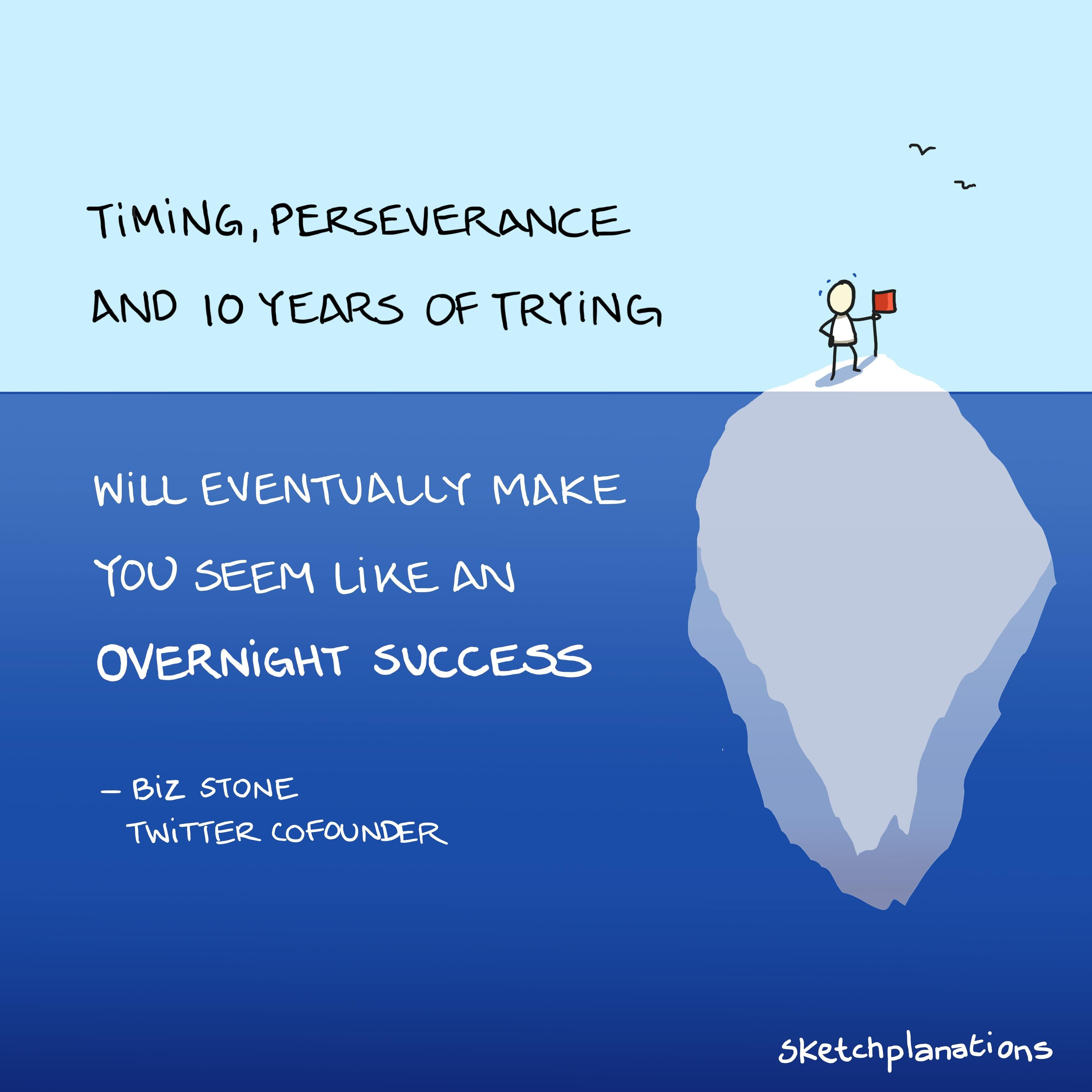
So much of building a business, research, cultural change, and improving a community or infrastructure happens like this. Our brains are great at missing slow, sustained changes. It’s a problem: we don’t easily notice when we’re making things worse slowly, but we also don’t notice when we’re making things better slowly. So many things are getting better in small ways, all the time, but it’s easy to miss.
I think the ability to keep chipping away and building sustainably over the years is so important. It doesn’t make the headlines most of the time, but it’s what makes the bulk of the positive changes in our lives.
Showing up and working hard are what give you the best chances for creative success. One of my favourite quotes is:
Inspiration usually comes during work, rather than before it.
— Madeleine L’Engle
You don’t trip over an opportunity if you’re sitting on the sofa.
How do you define success now?
Everybody becomes a unique blend of their experiences. I’m fortunate in that I’m in a position where I can, mostly, make the most of this combination. I think the freedom to do that, to build the life’s work that I want, building on my unique blend of experience, is the way I’d consider success.
What would you say to someone feeling discouraged by slow progress?
Patience is an underrated trait. Being patient and kind to yourself is important. The truth is that few things succeed or are great at first. Don’t rush, and don’t be hard on yourself if things don’t work out straight away. It’s all experience. You have to believe in yourself, or you’ll get washed around.
Congratulations! Reoccurring deadlines are brutal; I'm glad you found a schedule that worked for you.
So my question is, after listening to this interview, do ever have a concept stored away to use in the future that you aren't sure how you'll explain visually and then one day, you're at the market, say reaching for a mango, when it just hits you?