


Hello!
I hope you have been enjoying the world cup, if that’s your thing—I have—and that you’re not too hot.
This week something I’d wondered about for a long time. Now I have the words for it.
It’s been about a year since I moved the newsletter over here. Thanks to everyone who’s supported me now and in the past. You make it possible for everyone 🙏
Jono
When I was first learning French at school, I was confused to see that London was known as Londres. It already had a name that people in the UK use. Why did it need another? Then, of course, I gradually realised that I was doing the same with names all over the world.
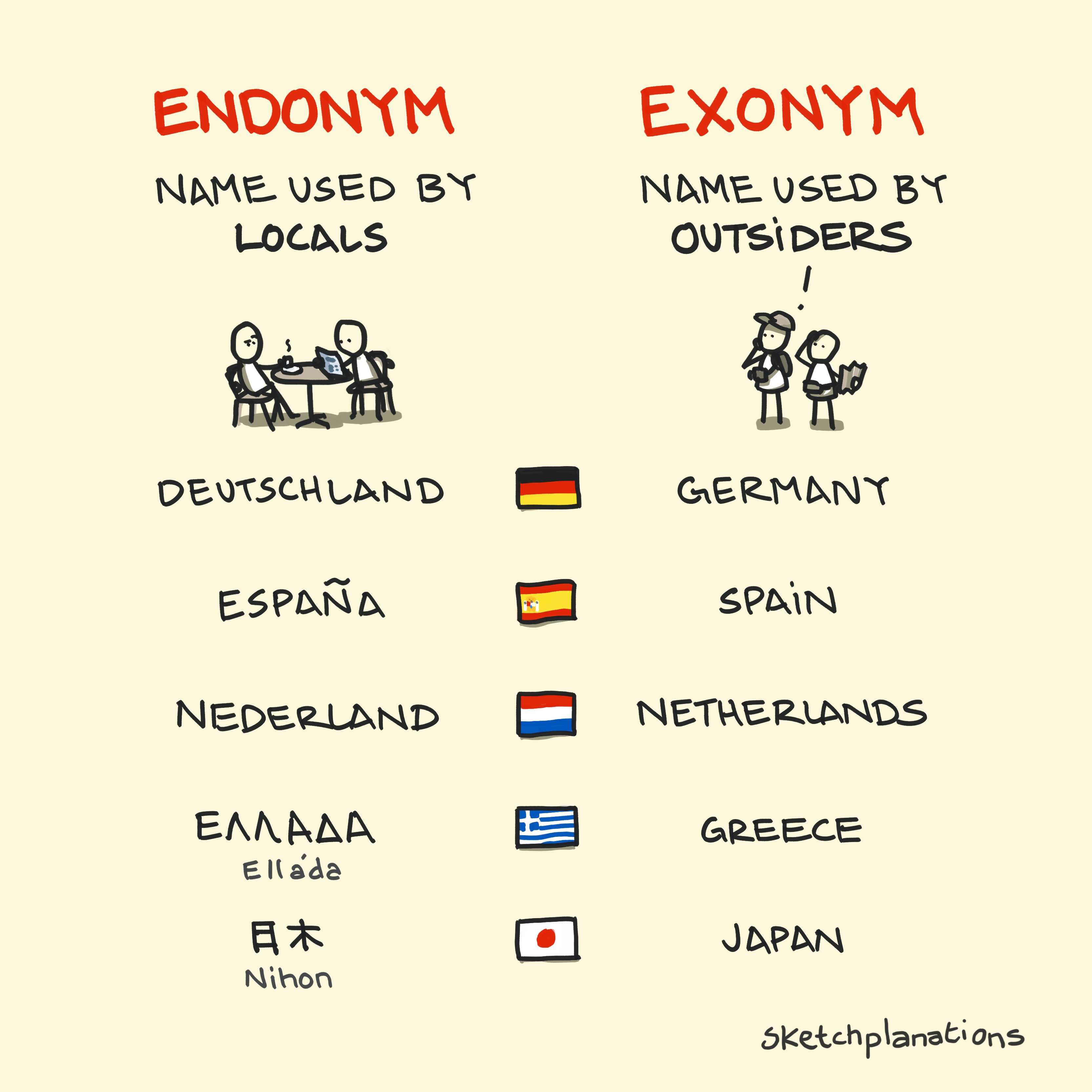
Germany is called Deutschland by Germans. Spain is called España. Italy, Italia. And on and on. I grew up knowing Holland, only later realising the proper English name is the Netherlands (low countries), but to the Dutch who live there, it’s Nederland.
It was only years later that I learned about endonyms and exonyms.
An endonym is the name locals use for a place.
An exonym is a name used by outsiders for a place.
Sometimes it can lead to genuine confusion. In a piece of family history, while driving through Italy with friends as a young man, I’m told my Dad decided to steer clear of what looked like the “gritty Northern industrial town” of Firenze, not realising they had just driven past Florence, one of the most beautiful cities in Europe the world and the birthplace of the Renaissance.
Etymology of endonym and exonym
Onym derives from the Greek word “onoma,” meaning “name.” For example, as we have in anonymous: without a name.
Endonym is made up of end- (within) and -onym (name). So endonyms are literally the name from within—what the natives call it. Endonyms are sometimes called autonyms as a self-name—what I call myself—from auto- (self).
Exonym is made up of ex- (outside) and -onym (name), making it the name from outside.
Reasons for Exonyms
Just as eponyms always have a story, exonyms always have a reason.
As an oversimplification, exonyms may exist from differences in language and letters (some languages lack the sounds of others), ease of pronunciation, literal translation (eg Pays Bas means Low Countries in French, just as the Netherlands does in English), and historical reasons.
Exonyms are frequently political and often contentious. They’re also not just for countries. The British, who mapped and named many things around the world, are responsible for many exonyms, many of which have since been officially changed. To name just a few:
Mt Everest was named after Sir George Everest, who never even saw the mountain. It has both a Nepali endonym (Sagarmāthā) and a Tibetan endonym (Chomolungma).
Mount McKinley was named in 1896 by prospector William Dickey after presidential candidate, and later president, William McKinley. It was returned to the traditional Koyukon Athabaskan name, Denali by President Obama in 2015. In Jan 2025, Donald Trump signed an executive order returning it to Mt McKinley. The encompassing area remains as Denali National Park and Preserve.
Uluru, the world’s largest monolith, is the native Aboriginal name of Ayers Rock, a name given by a European Surveyor in 1873.
London or Lontoo
Exonyms are language-specific. Back to London, Londres is London in French. But in Finnish it’s Lontoo. Wikipedia’s article on endonyms and exonyms gives a remarkable array of names for London:
Londres in French, Spanish and others
Λονδίνο in Greek
Londen in Dutch
Londra in Italian and others
Londër in Albanian
Londýn in Czech and Slovak)
Londyn in Polish)
Rānana in Māori
Lundúnir in Icelandic
Londain in Irish
Llundain in Welsh
Lontoo in Finnish
Luân Đôn in Vietnamese
لندن (Landan) in Persian, Arabic, Urdu
伦敦 Lúndūn in Mandarin
I had no idea.
World Cup Endonyms and Exonyms
We’re in the middle of the FIFA World Cup 2026, and there are many good examples of endonyms and exonyms. And many more people now know where the Cape Verde Islands are and where the small island of Curaçao is. Here are some of the endonyms and their English exonyms from countries that have been competing.
🇩🇪 Deutschland - Germany
🇲🇦 al-Maghrib / المغرب - Morocco
🇪🇬 Misr / مصر - Egypt
🇯🇵 Nihon / 日本 - Japan
🇰🇷 Hanguk / 한국 - South Korea
🇭🇷 Hrvatska - Croatia
🇬🇷 Elláda / ΕΛΛΑΔΑ - Greece
🇹🇷 Türkiye - Turkey
🇦🇹 Österreich - Austria
🇨🇮 Côte d’Ivoire - Ivory Coast
🇳🇱 Nederland - Netherlands
🇪🇸 España - Spain
🇸🇪 Sverige - Sweden
🇳🇴 Norge - Norway
🇮🇶 al-‘Iraq / العراق - Iraq
🇯🇴 al-Urdunn / الأردن - Jordan
🇩🇿 al-Jaza’ir / الجزائر - Algeria
🇸🇦 as-Su’udiyya / السعودية - Saudi Arabia
🇹🇳 Tūnis / تونس - Tunisia
🇨🇭 Schweiz / Suisse / Svizzera / Svizra - Switzerland
🇧🇪 België / Belgique / Belgien - Belgium
🇨🇩 República Democrática do Congo / République démocratique du Congo - DR Congo
🇧🇦 Bosna i Hercegovina / Босна и Херцеговина - Bosnia and Herzegovina
🇨🇿 Česko - Czech Republic / Czechia
🇭🇹 Hayti / Ayiti - Haiti
🇨🇻 Cabo Verde - Cape Verde
🇺🇿 O‘zbekiston - Uzbekistan
🇧🇷 Brasil - Brazil
🇲🇽 México - Mexico
Related Ideas to Endonyms and Exonyms
In case you wanted more name words to talk about:
Homonyms, homographs, homophones—I had an interesting (for me at least) chat with my niece about these recently after she talked to me about homographs.
While I can be reasonably authoritative on what the British call London, I am not, of course, an authority on what all the endonyms are around the world. Those listed here are to the best of my knowledge. Apologies if I have made any mistakes. If you notice something I should fix/improve, please let me know 🙏
Replay
Edit 24 Jul 26:
Updated to reflect Denali being renamed to Mount McKinley in Jan 2025.
Not sure if this one is technically an Enonym or Exonym, although it's also to do with Italy or rather Italian: the city of Munich in Germany is called Monaco in Italy. Wait, isn't that the same name as the Principality down there on the Cote d'Azur? Yes, it is, and it takes a while work out where exactly Monaco di Baviera is when hearing it formally spoken on, say the news for the first time. In everyday speach people tend to drop that disgnation for Munich, with you just having to guess which one they're talking about from the sentance.
OK, pedant's corner here: Firenze is one of the most beautiful cities in the whole wide world, not only in Europe. And, though there are many industrial towns in Northern Italy, none of them is gritty. Most of them were inhabited by Celtic populations, and renamed by Roman settlers – Augusta Taurinorum/Torino/Turin; Mediolanum/Milano/Milan – many other flourished in the Middle Ages and the Renaissance.
There was also a Roman London, Londinium, capital of Roman Britain. That city has more lives than a clowder of cats.