

Our brains love shortcuts
Have a look at this

Thanks to all my new and existing paid subscribers and patrons who keep this coming. You are brilliant. Ideas are always welcome for what you’d like to know about in paid posts.
Also, I found that lots of replies had gone to spam since I moved to the new platform. I fished them out. I don’t manage to respond to everyone, but I love reading your messages.
I wonder if this classic illusion is new to you:
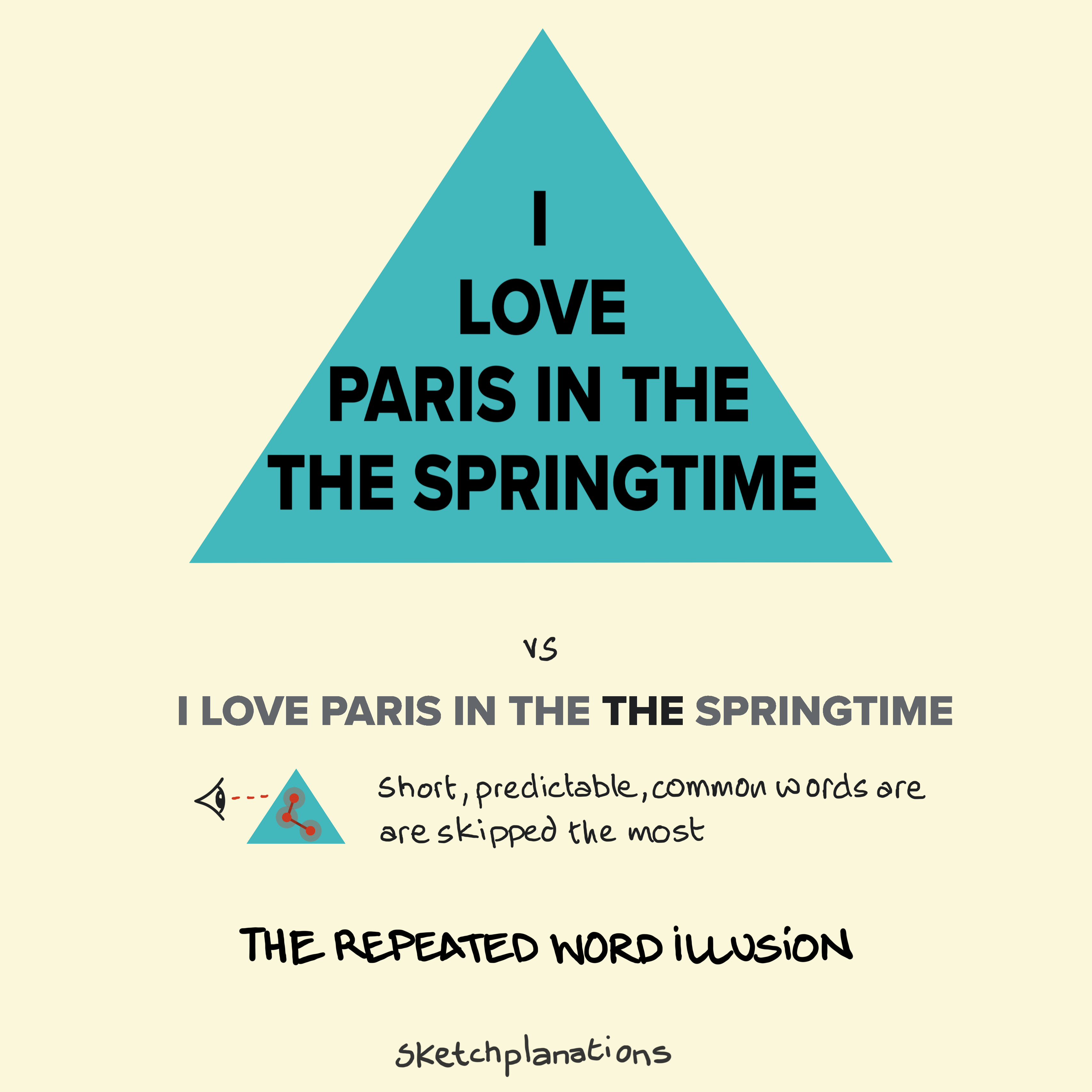
I distinctly remember the first time I saw this illusion. It definitely got me. My mind happily skipped past a 'the' without a second's notice. Why do our brains do that?
There are a few factors at work that let us completely miss repeated words when reading—even when they’re right in front of us.
Our minds love taking shortcuts
Thinking is expensive—it takes energy. So when our brain sees something familiar, it often skips ahead to save effort. We rely on mental shortcuts (heuristics) to help us move faster and more efficiently, but sometimes those shortcuts trip us up.
Top-down and bottom-up processing
When presented with a simple sentence, as in the sketch, our minds may engage in top-down processing, jumping straight to the meaning.
In contrast, when something is unfamiliar, important (like an exam), or when our role demands precision (like a proofreader), we tend to slow down and use bottom-up processing—scanning each word more carefully.
Saccades
When reading, our eyes don’t move smoothly along a line—they jump in quick bursts called saccades. How far we jump depends on word length, spacing, familiarity and complexity. Some words may be skipped entirely.
Short, common and predictable words
Paris and Springtime, though well known, are less common than "the". We are more likely to focus on the less usual, meaning-carrying words and skip short, common, predictable words.
Layout matters
By stacking the sentence in a pyramid, we subtly guide attention downward and to the right. That extra “the” hides off to the left, where we’re least likely to look back.
--
As I find so often the case, what we actually do when we read is much more complex and fascinating than I first realised.
May your reading be fast and accurate this week,
Jono
PS
Did you catch the repeated 'are', too?
Related Ideas to The Repeated Word Illusion
More illusions:
Also see:
More:
This paper has an interesting discussion of word skipping and reading models that try to understand and simulate what we really do when we read: Drieghe, D., Rayner, K., & Pollatsek, A. (2005). Eye movements and word skipping during reading revisited. Journal of Experimental Psychology: Human Perception and Performance, 31(5), 954.
I wasn't sure of the name of this illusion. If you know what it should be called, please let me know. Sorry for the vague title, but I didn’t want to spoil it for everybody.